
Tiffanie Darke: Reimagining Christmas for an Age of Excess
A season once built on rare abundance is now drowning in excess. Co-founder of Agora, activist and author Tiffanie Darke reflects on how to reclaim Christmas with intention by resisting mindless consumption and finding meaning in what we give, make and share.
JOIN THE RITUAL. SIGN UP FOR EXCLUSIVE CONTENT, EXPERT INSIGHTS,
RITUALS, STORIES, NEW LAUNCHES & EXPERIENCES
by Maya Boyd
I’ve been thinking a lot about how we navigate Christmas without letting it collapse into an unsustainable consumer frenzy. More and more people tell me they feel uneasy about the excess. There is a quiet sense now that something about the whole spectacle is out of step with the world we live in.
I find it helps to remember that Christmas was originally shaped in a completely different context. In Victorian Britain the idea of abundance was radical because most people lived with so little. A goose on the table might be the only meat a family saw for months. The notion of laying out more food than you could possibly eat was a deliberate moment of relief in an otherwise frugal life. It made sense in an age of lack.
But we do not live in lack. We live in excess. Everything is immediate, abundant and cheap. You can buy almost anything for €7.99, have it delivered the next morning and forget it by the end of the week. When everything is available all the time it loses its value.
© Jonas Allert, © Documerica
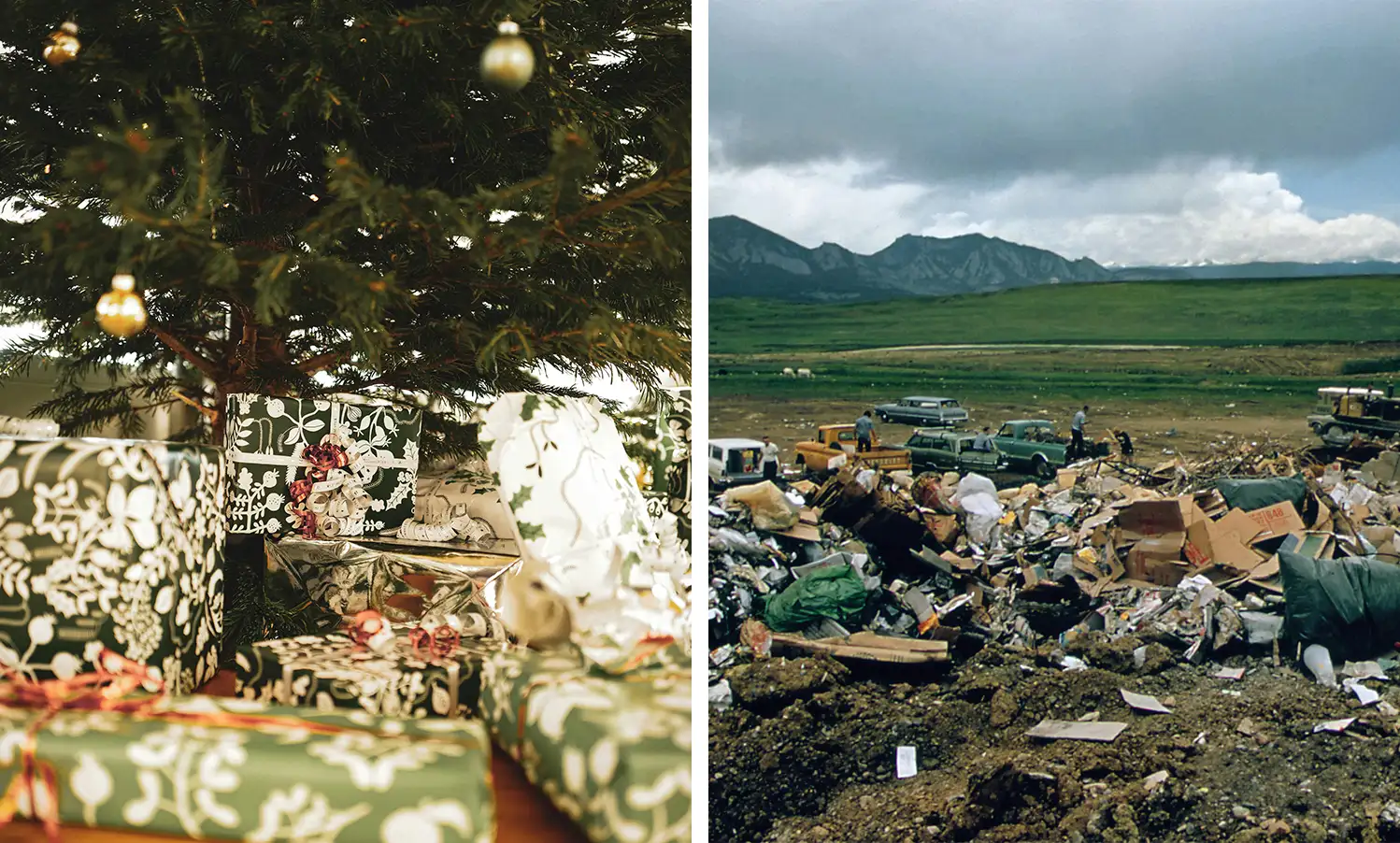
I still remember a Christmas when all the children and cousins were little. I walked into the sitting room and the carpet had vanished under a sea of presents. The children were thrilled yet something felt profoundly off. I cannot recall a single gift opened that day. They blurred into nothingness and I am certain most ended up as waste. A recent PwC audit found that close to ninety percent of Black Friday purchases go straight to landfill, which tells you everything about the system we are participating in.
So, the question is how we redefine a joyful Christmas for a culture that no longer needs more things. Our old idea of abundance is not making us happier and it is certainly not serving the planet. I’m certainly not against giving, but the issue is the thoughtlessness. My cousin and his grown children give each other poems every year which I think is beautiful. I once tried it with my own children and they vetoed it instantly, but the idea stays with me. Giving something of yourself feels far more meaningful than a late-night swipe on Amazon.
© @agora.ibiza on instagram
Books remain a brilliant option. They are personal and expansive and they hold ideas you can carry with you. For children I often ask mine to buy from charity shops. You can find extraordinary things for a few pounds. Cut glass decanters. Hair clips. Board games. Charity shops need the support because the second-hand market has been heavily commoditised by Vinted and eBay and Etsy, which has drawn both stock and customers away from them. Shopping there is a genuine act of support.
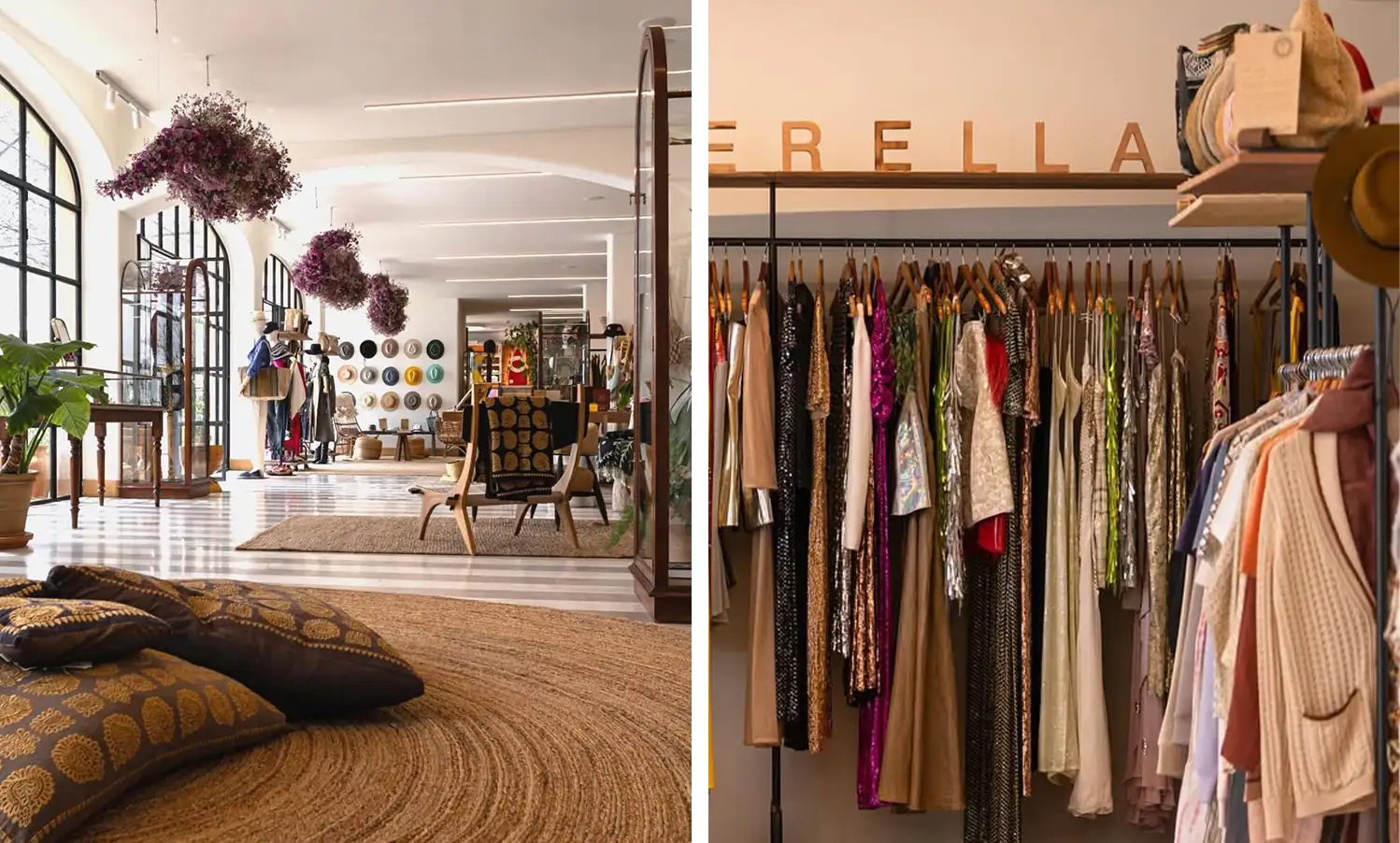
If you want to buy new choose a place that curates by purpose. That was the entire premise when Daniela Agnelli and I founded Agora. A store shaped by ethics rather than trends, where makers and meaning and social impact form the narrative. Lovebrook and Green is another strong platform that curates for integrity. But in truth the most satisfying gifts are often the ones you make. This year I asked for remnants of beautiful fabric from eBay. My daughter wanted a sewing machine so now we have one in the house. I plan to spend that strange ‘Twixmas’ period making cushions and napkins, which feels far more grounding than drifting through those days doing nothing useful. Food is always a good gift. I bake cakes for my neighbours. My mother-in-law makes marmalade. These gifts carry time and care which is why people cherish them.
© Olena Bohovyk, © Gaelle Marcel
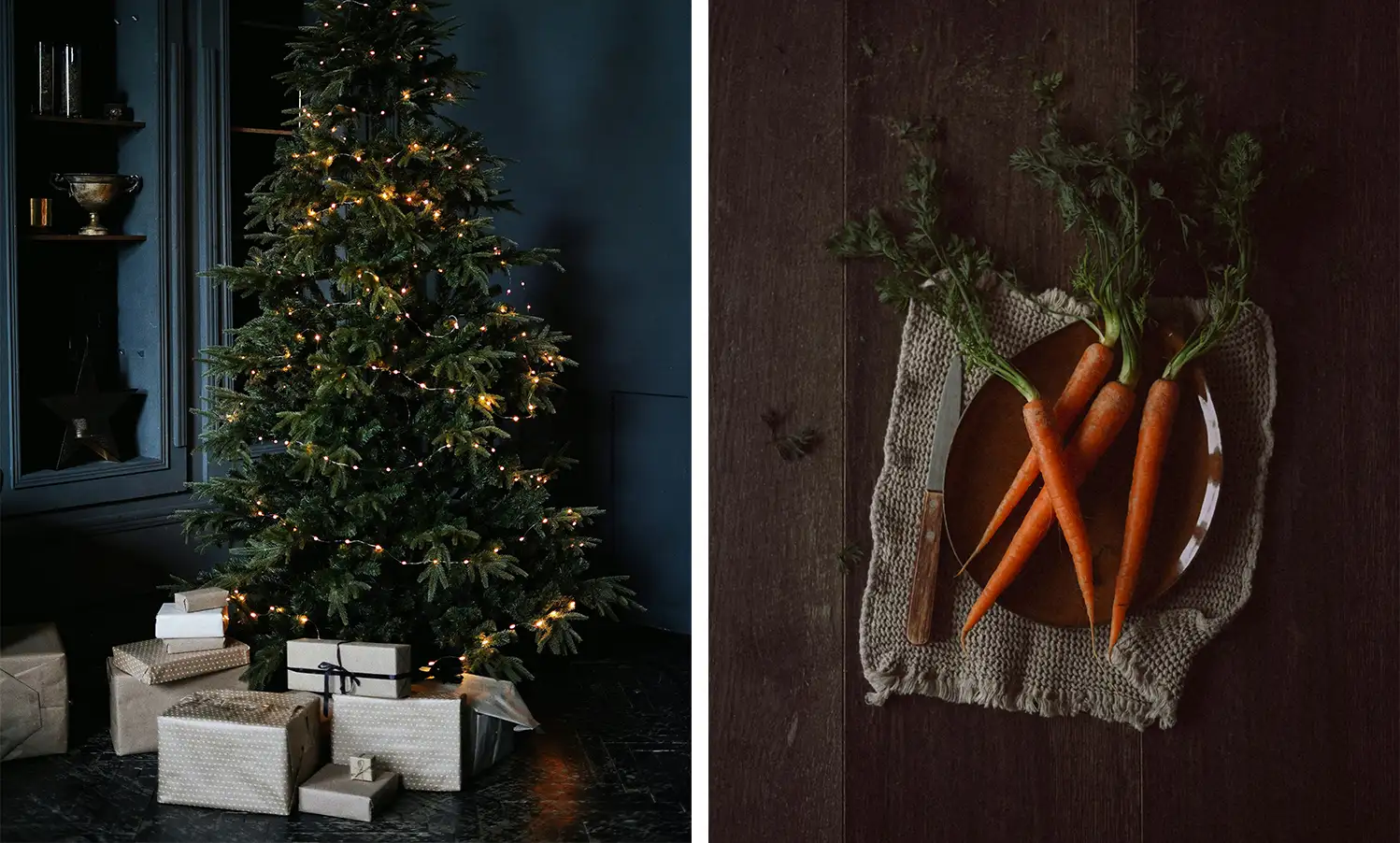
As for wrapping I avoid anything glossy. Most commercial wrapping paper cannot be recycled. I wrap in plain brown paper with string and a sprig of rosemary. Throughout the year I save ribbons and reuse them. Wool is also perfect as ribbon and comes in every colour.
Food-wise – if you’re hosting – try to choose local produce or at least seasonal, wherever you are. Make dishes that can actually be eaten the next day. Gratin style vegetables reheat beautifully. Brussels sprouts work well in bubble and squeak.
There are also things I simply ban. Glitter. Sequins. Both are pure plastic and shed everywhere. They feel like the worst possible symbol of temporary sparkle. No one needs them. So yes, this is my idea of an anti-Christmas Christmas. Not anti-joy and certainly not anti-tradition, but absolutely planet-first. A version that rejects waste and embraces intention. We have enough things. What we do not have enough of is thought.
by Maya Boyd
I’ve been thinking a lot about how we navigate Christmas without letting it collapse into an unsustainable consumer frenzy. More and more people tell me they feel uneasy about the excess. There is a quiet sense now that something about the whole spectacle is out of step with the world we live in.
I find it helps to remember that Christmas was originally shaped in a completely different context. In Victorian Britain the idea of abundance was radical because most people lived with so little. A goose on the table might be the only meat a family saw for months. The notion of laying out more food than you could possibly eat was a deliberate moment of relief in an otherwise frugal life. It made sense in an age of lack.
But we do not live in lack. We live in excess. Everything is immediate, abundant and cheap. You can buy almost anything for €7.99, have it delivered the next morning and forget it by the end of the week. When everything is available all the time it loses its value.
© Jonas Allert, © Documerica
I still remember a Christmas when all the children and cousins were little. I walked into the sitting room and the carpet had vanished under a sea of presents. The children were thrilled yet something felt profoundly off. I cannot recall a single gift opened that day. They blurred into nothingness and I am certain most ended up as waste. A recent PwC audit found that close to ninety percent of Black Friday purchases go straight to landfill, which tells you everything about the system we are participating in.
So, the question is how we redefine a joyful Christmas for a culture that no longer needs more things. Our old idea of abundance is not making us happier and it is certainly not serving the planet. I’m certainly not against giving, but the issue is the thoughtlessness. My cousin and his grown children give each other poems every year which I think is beautiful. I once tried it with my own children and they vetoed it instantly, but the idea stays with me. Giving something of yourself feels far more meaningful than a late-night swipe on Amazon.
© @agora.ibiza on instagram
Books remain a brilliant option. They are personal and expansive and they hold ideas you can carry with you. For children I often ask mine to buy from charity shops. You can find extraordinary things for a few pounds. Cut glass decanters. Hair clips. Board games. Charity shops need the support because the second-hand market has been heavily commoditised by Vinted and eBay and Etsy, which has drawn both stock and customers away from them. Shopping there is a genuine act of support.
If you want to buy new choose a place that curates by purpose. That was the entire premise when Daniela Agnelli and I founded Agora. A store shaped by ethics rather than trends, where makers and meaning and social impact form the narrative. Lovebrook and Green is another strong platform that curates for integrity. But in truth the most satisfying gifts are often the ones you make. This year I asked for remnants of beautiful fabric from eBay. My daughter wanted a sewing machine so now we have one in the house. I plan to spend that strange ‘Twixmas’ period making cushions and napkins, which feels far more grounding than drifting through those days doing nothing useful. Food is always a good gift. I bake cakes for my neighbours. My mother-in-law makes marmalade. These gifts carry time and care which is why people cherish them.
© Olena Bohovyk, © Gaelle Marcel
As for wrapping I avoid anything glossy. Most commercial wrapping paper cannot be recycled. I wrap in plain brown paper with string and a sprig of rosemary. Throughout the year I save ribbons and reuse them. Wool is also perfect as ribbon and comes in every colour.
Food-wise – if you’re hosting – try to choose local produce or at least seasonal, wherever you are. Make dishes that can actually be eaten the next day. Gratin style vegetables reheat beautifully. Brussels sprouts work well in bubble and squeak.
There are also things I simply ban. Glitter. Sequins. Both are pure plastic and shed everywhere. They feel like the worst possible symbol of temporary sparkle. No one needs them. So yes, this is my idea of an anti-Christmas Christmas. Not anti-joy and certainly not anti-tradition, but absolutely planet-first. A version that rejects waste and embraces intention. We have enough things. What we do not have enough of is thought.
DON’T MISS